
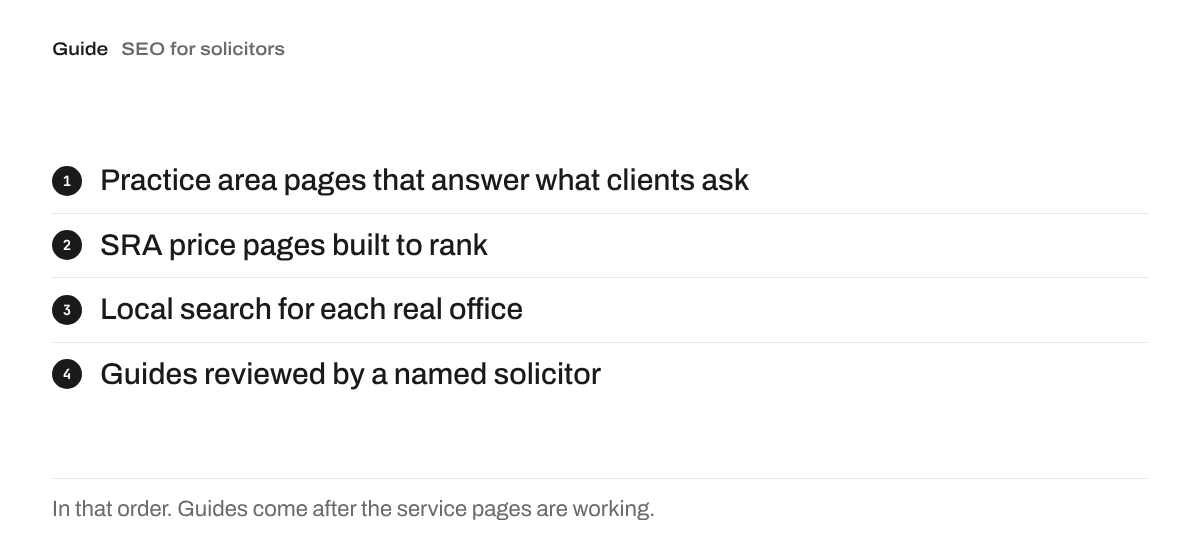
Law firms are the sector I've worked in most, mainly through agencies. The firms that do well in search usually have pages that answer what a client wants to know at the moment they're looking for a solicitor. Budget has less to do with it than people think.
This guide covers where I'd start with SEO for solicitors, in the order I'd do it on a firm's website. It's written for partners, practice managers and in-house marketers who want to know what good looks like before they hire anyone.
Start with the practice area pages
Someone looking for a solicitor rarely searches for a firm. They search for the thing they need: a conveyancing quote, a solicitor for a police interview, help with a will. Google sends them to the page that best matches that need, which on a law firm site is the practice area page.
So that's where the work starts. On most firm sites I look at, those pages have the same problems:
- One page covers too much. "Family law" as a single page has to compete with firms that have a page each for divorce, child arrangements and financial settlements.
- Individuals and businesses share a page. A homeowner and a company director searching for a property solicitor want different things, and one page can't speak to both.
- The copy describes the firm. "We are a friendly, experienced team" says nothing a client is searching for. They want to know what happens next, how long it takes and what it costs.
A good practice area page answers the questions a client would ask on the phone, in the order they'd ask them. If your fee earners hear the same five questions every week, those questions belong on the page.
Turn your SRA price pages into pages that rank
If your firm advertises conveyancing, probate, employment tribunal claims or a handful of other services, the SRA Transparency Rules say you have to publish prices for them on your website, somewhere prominent. The full list of services is on my SEO for law firms page.
Most firms treat this as a compliance job: one PDF or one long page, linked from the footer. About 590 people a month search "how much does conveyancing cost", and you already have to publish the answer.
Give each service its own page, with the price, what's included, what isn't and how long it usually takes. That page does the compliance job and gives Google something to rank. It also reassures someone comparing three firms, which is the moment they're most likely to call.
I'm not a solicitor, so anything I draft on fees or regulation is checked by the firm before it goes live.
Get local search right for each office
Plenty of legal searches are local. Someone arrested tonight, or buying a house in a particular town, wants a solicitor they can reach. For each office, get two things right:
- A Google Business Profile for every office, with the right category, opening hours and a link to the page for that office's main services.
- Location pages only where you have an office. A page for every town within fifty miles, with the town name swapped in, is the kind of thin page Google tends to ignore. A page for each real office, with the people who work there and the services they offer, is worth having.
On a criminal defence firm I worked on, a page for each office picked up local searches for prison law and criminal defence solicitors. More on that firm's guides in the next section.
Write guides for the questions clients ask before they call
Search for "SEO for solicitors" and most of page one is guides like this one. Your clients search the same way. Before they call, they look up what a voluntary police interview is, how long probate takes or who decides the completion date.
Those searches are a way in for a firm that can't yet outrank national names on "criminal defence solicitors". On that criminal defence firm, the guide and location pages I worked on went from about 140 to about 1,500 estimated monthly visits in four months, and most of the lift arrived in the month after I'd finished. On four new law firm sites I wrote launch content for through an agency, an FAQ on how to sue someone went from 48th to 5th for its main search.
What makes a legal guide work:
- It answers one question properly. Pick questions your firm handles and can answer with authority, from your own search data and the questions clients ask your team.
- A named solicitor reviews it. Google is stricter with legal content than most, because a bad answer can cost someone their home or their freedom. Show who wrote or reviewed it and their credentials, and keep it current when the law changes.
- It links to the service. Every guide should point the reader to the practice area page it supports, so someone ready to act knows where to go.
Guides come after the practice area pages. A guide that ranks but sends readers to a weak service page brings in visits that don't turn into enquiries.
Fix the technical problems from past rebuilds
Law firm sites tend to carry history: old news pages nobody reads, duplicate service pages from a previous site, links broken in the last rebuild. Each issue is small, but between them Google spends time crawling pages that will never bring in a client.
A crawl and an hour in Search Console usually show the worst of it, and this is the technical SEO work I'd do first on most firm sites. Merge or redirect the duplicates, fix the broken internal links and let the old news archive stop competing with your service pages. If a new website is on the way, sort the redirects out before launch: I keep a free website migration checklist for exactly that.
Measure enquiries by practice area
Traffic is a poor measure for a law firm. A few hundred visits a month to a criminal law guide can be worth more than thousands of visits to a generic legal explainer.
What you want to know is which practice areas bring in enquiries, and from which pages. That means tracking calls, form submissions and emails, split by practice area. It takes a little setting up, but it's the only way to see whether law firm SEO is paying for itself, and where to put the next month's effort.
Where to start this week
Start here: open Search Console, look at the pages that already get impressions for your main services, and read them as a client would. Does each one answer what that client needs to know before they call? If not, that's your first job, and it's usually a bigger win than anything else on this list.
If you'd like someone to work through this with your firm, here's how I work with law firms.