
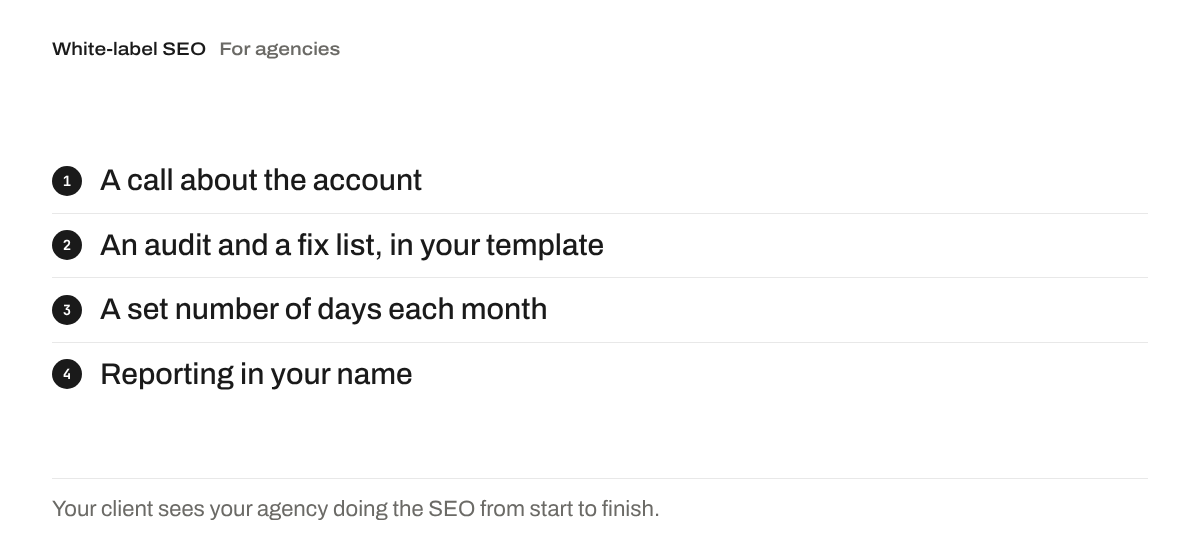
White-label SEO is SEO delivered under your agency's brand by someone outside your agency. Your client sees you doing the SEO from start to finish. The partner does the work behind the scenes, in your templates and your name, and you set the price.
Most of my recent work has been done this way, so this is how it looks from the partner's side of the table. The first thing to know is that two quite different services get sold under the same label.
The two kinds of white-label SEO
The first is a reseller package. You buy a fixed set of deliverables each month, the production happens somewhere you never see, and the client gets a branded dashboard. It suits accounts where a steady set of monthly deliverables covers what the site needs.
The second is a senior consultant working inside your agency for the account. They audit the site, decide what matters, make the fixes in the CMS where they have access, and write the reporting you forward to the client. If you want them on the client call, they join it as part of your team.
Either can be the right fit. Problems tend to show up when a site with technical issues gets a package built for routine monthly work. If your client's site has indexing problems or a migration coming up, a fixed package of monthly deliverables isn't built for that.
What white-label SEO usually includes
With the consultant kind, the scope follows the site. On any one account it can cover:
- an SEO audit with a fix list in priority order, in your template
- technical fixes made directly in the CMS, where there's access
- on-page work on existing pages: titles, descriptions, headings, internal links and content updates
- keyword research and a content plan sized to the days available
- briefs for your writers, or copy ready to upload
- the SEO side of a website rebuild: requirements, redirect maps and launch checks
- monthly reporting in your name
A reseller package tends to list fixed monthly items instead, so the question to ask is whether the list was written for your client's site or for every site.
How a white-label SEO engagement runs
The details change with the account, but the shape is usually the same:
- You tell me about the account. Who the client is, what you've sold them and what access exists. NDA first if you want one.
- Access and a baseline. Search Console comes first, then the CMS and analytics if they're available. Nothing gets changed until I know where the site stands.
- Audit and fix list. Every issue is scored for impact and effort, so the list starts with the fixes that matter most and cost least. It goes out in your template, or in an unbranded document you put your logo on.
- Monthly delivery. A set number of days each month: fixes in the CMS, page updates, briefs or copy. Each change is noted with its date, so a movement in the data can be traced to the work behind it.
- Reporting in your name. A monthly update you can forward as it is, written for the client rather than for another SEO.
You stay the client's only contact throughout. If an account needs me on a call, I join as part of your team. The white-label SEO services page covers what I take on for agencies.
Reseller package, consultant or in-house hire
These are the three ways an agency usually covers SEO, and each suits a different situation.
| Reseller package | Senior consultant | In-house hire | |
|---|---|---|---|
| Who does the work | A production team you don't see | One named specialist | Your own employee |
| Scope | A fixed list of monthly deliverables | Whatever the site needs, within agreed days | Whatever you assign |
| Fixes in the CMS | Rarely; usually a report for the developer | Yes, where there's access | Yes |
| Commitment | Monthly per client | Per account, monthly or per project | Salary, whether or not the accounts are there |
| Best for | Steady sites with routine needs | Sites with technical issues, migrations or real competition | Agencies with enough SEO work to fill a full-time role |
A reseller package is the cheapest way to say yes to a client, as long as the site fits the package. A consultant usually costs more, but the time goes on whatever is holding the site back. Hiring only makes sense once there's enough SEO work across your accounts to keep someone busy every week.
How white-label SEO is priced
Reseller packages are usually a fixed monthly fee per client, with tiers that add deliverables. Consultants usually work on a day rate, either as a monthly retainer of a set number of days across your accounts or as a project quoted in days. Either way, you set what the client pays, and the margin is yours.
Whichever model you look at, ask what the price includes and what happens when the site needs something outside the list. A low monthly fee is poor value if the package can't fix the problem the client is paying to solve.
The pros and cons for your agency
The case for it is mostly about capacity and margin. You can say yes when a client asks about search, without hiring a full-time SEO for a handful of accounts. You get senior skills on the accounts that need them, for as long as they need them, and you set the price you resell at.
There are downsides, and it's worth planning for them:
- Your partner's capacity becomes your capacity. If they're full, your new account waits.
- Quality is in someone else's hands, so you need a partner whose work you'd happily put your name on.
- Your account team still needs to understand the work well enough to answer a client's question on a call.
- If the partner leaves, you need the documents, the access and the history to stay with you.
Each one is manageable if you choose the partner carefully, which is what the questions below are for.
Questions to ask a white-label SEO partner
Will you sign our NDA? A good partner says yes before you've shared anything about the client.
Do you contact our clients? The right answer is no, unless you ask them to. Everything should come to you, in your templates or in plain documents you can put your logo on.
Can you work in the client's CMS? This one makes a big difference. If your partner can make the fixes themselves, they go live much sooner. On one property account, making the changes in the CMS directly is what got them live quickly. If all a partner can do is send a spreadsheet to the client's developer, the fixes join the developer's queue with everything else.
Which tools do you use? Search Console should come first, because that's Google's own data. A crawler sits alongside it, and keyword tools too, though their numbers are estimates. If you already pay for licences, a good partner will happily use yours.
What happens when the client wants something you wouldn't recommend? You want the recommendation in writing, with the reasoning, and then the work done the client's way if they've got a good business reason. That way, if it comes up again later, the advice is on record.
Who owns the work if we part ways? Agree this before you start. Everything you've paid for, including access, should sit in your accounts or your client's, never only in the partner's.
How many accounts can you take? It depends on the days each account needs, and the days have to come from somewhere. A partner who's honest about capacity will tell you when they're full.
How do we communicate? Email for anything that needs a record, Slack or Teams for quick questions, and the partner on client calls if the account needs it. Agree which up front.
Before you sign one
Ask to see results that were delivered through other agencies, with the data behind them. Almost every case study on this site was delivered through an agency. Each is anonymised to sector, with the source for every number.
Delivered white-label, via a digital agency
Finding a noindexed property, then the template problems behind 354 pages
Student accommodation operator, dozens of UK properties on one multi-property website. Spring 2026 to present, white-label, via a digital agency.
Read the case study- 7,301 to 26,265impressions, 30 days before vs 30 days after
- 13 of 14of the property's pages set to noindex
- 354pages flagged by the audit, traced to three template causes
Search Console
If you've got an account that needs proper SEO and nobody in-house to do it, that's what my white-label SEO services for agencies are for. Tell me about the account and I'll tell you how I'd approach it and how many days it needs.